Buying Signals Explained: How to Identify Sales Opportunities Before Your Competitors
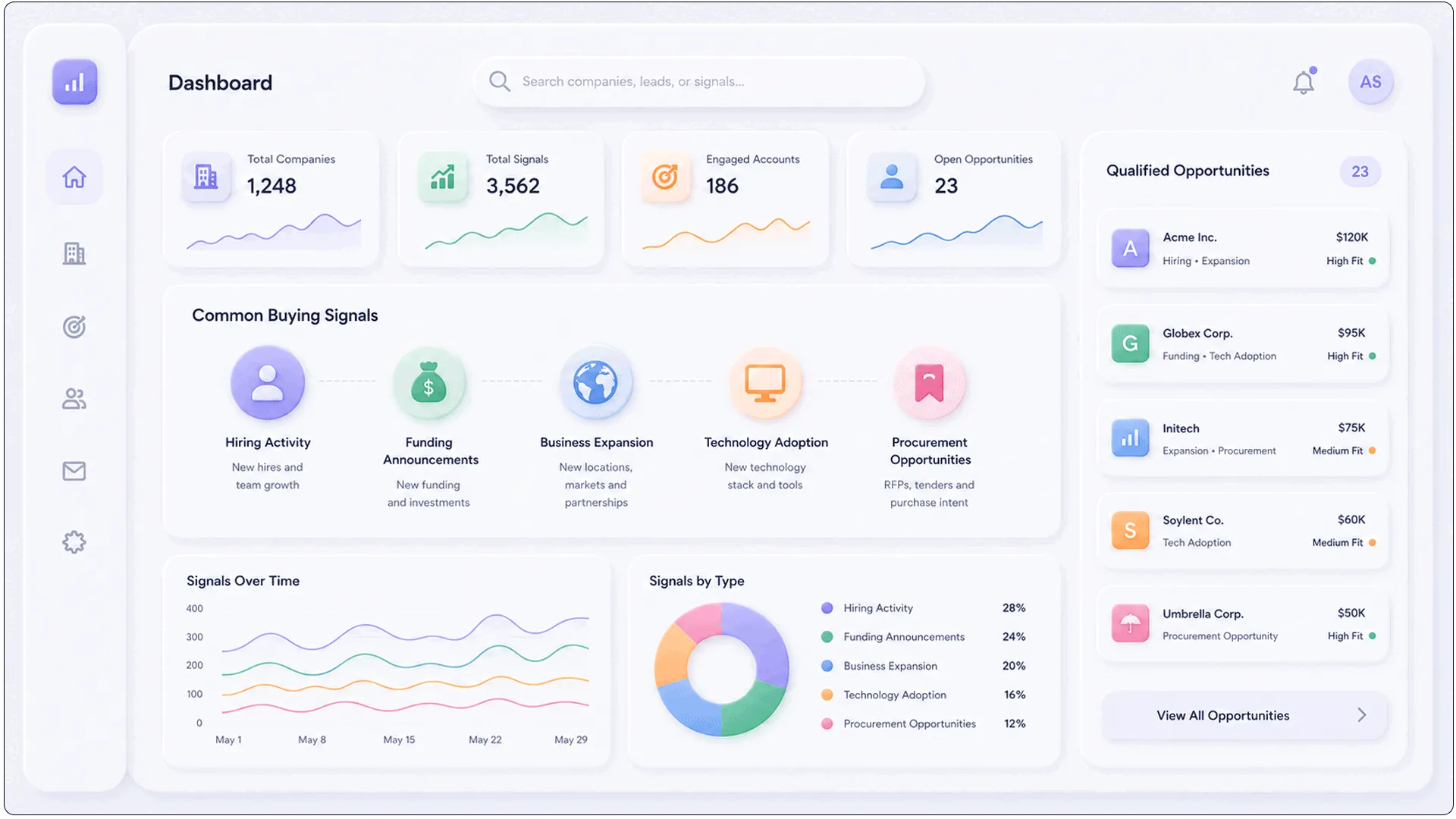
Finding the right prospect is only part of successful business development. The real challenge is knowing when a business is most likely to need your product or service.
Two companies may fit your ideal customer profile perfectly, but one may be actively planning new investments while the other has no immediate need. Reaching out at the right time can make the difference between a meaningful conversation and an ignored email.
This is where buying signals become valuable.
Buying signals are indicators that suggest a business may be preparing to purchase a product, hire a service provider, or invest in new technology. Recognizing these signals helps agencies, freelancers, consultants, and sales teams prioritize opportunities that are more likely to convert.
If you're new to AI-powered prospecting, start with our AI Lead Discovery: The Complete Guide to Finding Qualified Leads in 2026 to understand how buying signals fit into a modern lead discovery strategy.
In this guide, you'll learn what buying signals are, why they matter, the most common types to monitor, and how AI helps businesses discover opportunities before their competitors.
Quick Answer
Buying signals are actions or events that indicate a business may be ready to purchase a product or service. These signals include hiring activity, funding announcements, company expansion, technology adoption, procurement requests, and other indicators of business growth. By monitoring buying signals, businesses can prioritize qualified opportunities and improve the timing of their outreach.
Why Buying Signals Matter
Timing is one of the most important factors in sales and business development.
Even the best outreach campaign can fail if a prospect isn't currently looking for a solution.
Buying signals help answer questions such as:
- Is this company actively growing?
- Are they likely to need external services?
- Is now the right time to reach out?
- Does this opportunity match our ideal client profile?
Instead of contacting every business that fits your target audience, you can focus on organizations showing signs of active investment or change.
This approach improves efficiency while reducing time spent on low-priority prospects.
Common Types of Buying Signals
Not every signal carries the same weight, but together they help build a clearer picture of potential buying intent.
1. Hiring Activity
One of the strongest indicators of growth is hiring.
When companies begin recruiting for multiple positions, they're often preparing to expand operations, launch new initiatives, or scale existing teams.
Examples include hiring for:
- Marketing Managers
- Sales Representatives
- Software Engineers
- Customer Success Specialists
- Operations Managers
These companies may soon require services such as marketing support, CRM implementation, recruitment software, training, or operational consulting.
For agencies, hiring trends can reveal businesses that are preparing to invest in external expertise.
2. Funding Announcements
Businesses that secure new investment often increase spending across multiple departments.
Whether it's seed funding, Series A, or later-stage investment, funding announcements often indicate upcoming budgets for:
- Marketing
- Sales
- Technology
- Product development
- Business consulting
- Recruitment
Monitoring recently funded companies helps identify organizations entering a new phase of growth.
3. Business Expansion
Growth doesn't always involve funding.
A company opening new offices, expanding into additional markets, or launching new products is often preparing for increased demand.
These businesses may need:
- Website improvements
- Marketing campaigns
- Sales enablement
- Software implementation
- Customer support solutions
Recognizing expansion early creates opportunities to start conversations before competitors.
4. Technology Adoption
Companies frequently adopt new software as they grow.
For example, implementing a CRM, a marketing automation platform, an analytics solution, or a project management tool often creates opportunities for consultants, agencies, and integration partners.
Technology changes may also indicate that a company is modernizing its operations and investing in future growth.
5. Procurement Opportunities
Many organizations publish Requests for Proposals (RFPs), tenders, or procurement notices when looking for vendors.
These opportunities are particularly valuable because the buying intent is explicit.
Instead of convincing a business that it needs your service, you're responding to an existing requirement.
Monitoring procurement opportunities manually can be time-consuming, so many businesses rely on AI-powered systems to track them continuously.
Buying Signals vs Lead Generation
Buying signals are often confused with lead generation, but they serve different purposes.
Lead generation focuses on attracting or collecting potential customers.
Buying signals help determine when those prospects are most likely to need your services.
If you're unsure about the distinction between lead discovery and lead generation, read our guide, "Lead Discovery vs Lead Generation: What's the Difference?"
Understanding both concepts helps businesses prioritize the right opportunities while building more effective outreach campaigns.
How AI Makes Buying Signals More Actionable
Tracking buying signals manually across dozens of websites, news sources, job boards, procurement portals, and company announcements is difficult and time-consuming.
AI simplifies this process by continuously monitoring multiple sources, identifying relevant events, and highlighting opportunities that match your Ideal Customer Profile (ICP).
Instead of spending hours researching businesses every day, teams can focus on reviewing qualified opportunities and engaging prospects at the right time.
Platforms like Scoutance support this process by monitoring over 50 sources, helping agencies and freelancers discover relevant business opportunities and reduce manual prospecting.
How to Use Buying Signals Effectively
Knowing what buying signals are is only the first step. The real value comes from using them to prioritize your outreach and focus on businesses that are more likely to become customers.
Instead of treating every prospect the same, create a process that combines buying signals with your Ideal Customer Profile (ICP).
A simple framework looks like this:
Define Your ICP → Monitor Buying Signals → Qualify Opportunities → Personalize Outreach → Follow Up → Measure Results
This approach helps your team spend less time researching prospects and more time having meaningful conversations with businesses that are actively growing or investing.
Combine Multiple Signals Instead of Relying on One
A single buying signal doesn't always indicate immediate purchase intent.
For example, a company hiring one employee doesn't necessarily need your services. However, if that same company is also expanding into a new market, has recently secured funding, and has launched a new product, the opportunity becomes much stronger.
Looking at multiple signals together provides a clearer picture of buying intent and helps prioritize outreach more effectively.
Personalize Your Outreach
Buying signals should influence how you start conversations.
Instead of sending a generic sales email, reference the event that caught your attention.
For example:
- Congratulate the company on its recent funding.
- Mention its expansion into a new region.
- Reference a recent product launch.
- Acknowledge new hiring activity.
This demonstrates that your outreach is based on genuine research rather than a mass email campaign.
For agencies, buying signals become even more valuable when combined with a structured client acquisition strategy. Learn more in our guide, How Agencies Can Find New Clients Consistently in 2026, which covers practical methods for building a predictable pipeline of qualified opportunities.
Review Buying Signals Regularly
Business activity changes quickly.
A company that wasn't a good fit last month may become an ideal prospect after announcing expansion or opening new positions.
Review buying signals consistently to ensure your pipeline includes fresh opportunities, rather than relying on outdated prospect lists.
If your team is manually monitoring multiple websites, it can quickly become difficult to manage. AI-powered lead discovery platforms help automate this process by continuously tracking relevant business activity across multiple sources.
Common Mistakes to Avoid
Focusing Only on Company Size
Large companies aren't always the best opportunities.
Smaller businesses experiencing rapid growth often have stronger buying intent and faster decision-making processes.
Always evaluate business activity alongside company size.
Ignoring Timing
Even if a business perfectly matches your Ideal Customer Profile, reaching out at the wrong time may result in low engagement.
Buying signals help improve timing by identifying organizations that are actively investing, hiring, or expanding.
Using Outdated Prospect Lists
Static contact databases become outdated quickly.
Companies change priorities, budgets shift, and decision-makers move to new roles.
Continuously monitoring buying signals helps keep your prospect list relevant.
Sending Generic Outreach
Buying signals provide context.
Use that information to personalize your messaging rather than sending identical emails to every prospect.
Relevant outreach consistently performs better than generic sales messages.
Real-World Examples of Buying Signals
Understanding buying signals becomes easier when viewed through practical scenarios.
Example 1: Growing SaaS Company
A SaaS company announces a Series A funding round and begins hiring sales representatives and customer success managers.
Possible opportunities include:
- CRM implementation
- Sales enablement
- Marketing services
- Customer onboarding solutions
Example 2: Digital Agency Prospect
A retail business launches a new eCommerce website while advertising for a Digital Marketing Manager.
This may indicate upcoming investments in:
- SEO
- Paid advertising
- Content marketing
- Conversion optimization
Example 3: Technology Modernization
A manufacturing company adopts a new ERP system and advertises several IT positions.
Potential opportunities include:
- Software integrations
- Staff training
- Cybersecurity consulting
- Business process optimization
Each example demonstrates how buying signals provide valuable context before outreach begins.
Key Takeaways
- Buying signals help identify businesses that are more likely to purchase products or services.
- Common buying signals include hiring activity, funding announcements, expansion, technology adoption, and procurement opportunities.
- Combining buying signals with a well-defined Ideal Customer Profile improves lead quality.
- AI-powered lead discovery makes it easier to monitor buying signals across multiple sources.
- Personalized outreach based on buying signals often performs better than generic prospecting.
Frequently Asked Questions
Q1. What are buying signals in sales?
Buying signals are actions or events that suggest a business may be preparing to purchase a product or service. Examples include hiring activity, funding announcements, expansion, and procurement requests.
Q2. Why are buying signals important?
They help businesses identify qualified opportunities and improve the timing of outreach, increasing the likelihood of meaningful conversations and successful conversions.
Q3. Can AI identify buying signals?
Yes. AI can monitor multiple public data sources, detect relevant business events, and surface opportunities that align with your Ideal Customer Profile more efficiently than manual research can.
Q4. Are buying signals the same as buying intent?
Not exactly.
Buying signals are observable events or behaviors that may indicate purchase intent. Buying intent refers to the likelihood that a business is actively considering a purchase. Multiple buying signals together often provide a stronger indication of intent.
Q5. How do buying signals improve lead discovery?
Buying signals help prioritize businesses that are actively growing or changing, making lead discovery more focused and increasing the chances of connecting with qualified opportunities.
Conclusion
Successful prospecting is about more than finding businesses that match your target audience; it's about identifying the right businesses at the right time.
Buying signals provide valuable context that helps agencies, freelancers, consultants, and B2B teams prioritize opportunities with greater confidence.
By combining buying signals with a clear Ideal Customer Profile and a structured lead discovery process, businesses can reduce manual research, improve the timing of outreach, and build a more predictable sales pipeline.
As AI continues to transform business development, the ability to detect and act on buying signals will become an increasingly important advantage for teams looking to stay ahead of the competition.